Tuesday, September 23, 2008

Technical Writer vs Software Architect
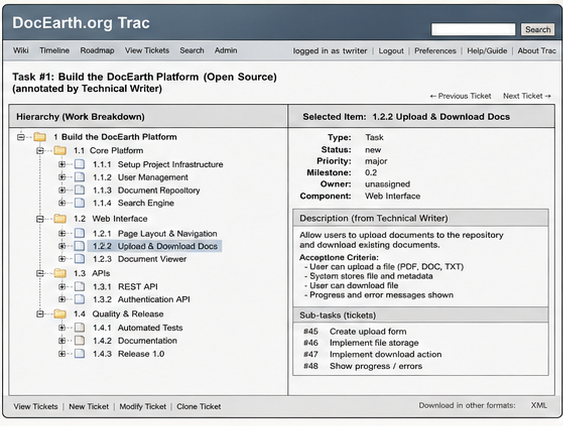

The first technical writer we hired to work on with a project lead to break an open source software project down into subprojects concluded that she is under qualified. The following are key excerpts of a chat between her and the project lead.

[09:28] Project lead: So, here is what I suggest:
[09:29] Project lead: - a platform specific hardware binding API for the MPEG decoder to talk with that platform's sound output
[09:29] Technical writer: ok
[09:31] Project lead: - a subproject to factor out the MPEG decoder from SDL in SMPEG
library, and remove the dependency on SDL, and instead use the hardware binding API.
[09:31] Project lead: - a subproject for each target platform to implement the hardware
binding API for that platform.
[09:32] Project lead: that's the high level of what needs to be done.
[09:32] Project lead: so what should we do next?
[09:33] Project lead: Maybe you should ask me some questions to better understand each
of those?
[09:35] Project lead: Oh, I think I missed: - define the API for the library, and create two samples to that uses the library; one basic playback, and one that uses all features.


It seems that these requirements overwhelmed our technical writer. As such she thought it would be better if we fine someone more qualified. We're currently looking to hire someone who has experience in software design and development as well as documentation (see image).

Other developments:
1. Today we signed the contract with Emblematiq to redesign our home page.

2. I'm reading the book Essential Software Architecture by Ian Gorton. The book was recommended by software architecture Proff at UW Richard Holt. Hopefully I come up w/ something interesting out of it.

Thursday, September 18, 2008

Pidgin and Adium


Hey all,

Today I got back in touch with the guys from Pidgin and suggested the work with the technical writer we hired to break down the project into subprojects. He agreed though he said that he highly doubts that the A/V project could be broken down so that they're discrete enough to be effectively tackled by unrelated developers.

I responded by saying that there are many doubts, but empirical evidence concludes all discussion, to which he agreed.

Anyways another development was talking to the Adium guys. Adium is a protocol agnostic instant messaging client like Pidgin. I suggested they work with our technical writer as well on adding A/V to Adium itself (something like a sister project for Pidgin). They responded positively, however one interesting point they mentioned was that bounties haven't helped them much because a few people have the knowledge to do the work required.

Anyways we will work them on the idea further and see how far we can go with it.

Other developments:
I've tried hiring a company through Odesk from India. They're still going over the code of FOSS Factory and trying to understand the whole system. They said they will start work tomorrow. So far it seems that these folks are professional, responsive and have good communication skills. Hope things run smoothly.

Wednesday, September 17, 2008

Amazee, hiring overseas, home redesign and other developments


Hey folksters,

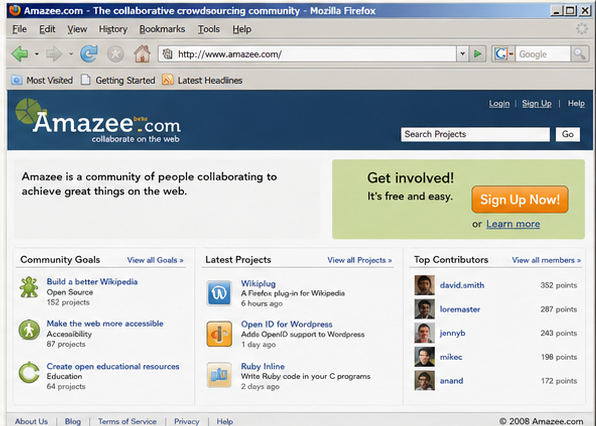
Today Ron Newman, an advisor of ours, asked me to take a check out Amazee.com

This is my take on the site. First off, like Cambrian House, they're everything to everyone. This invariably results in goals that are as diverse as it gets (with lots of very low quality ones, one goal i found on the site was to keep my house clean) Cambrian house is a proven failure by the way.

Very few projects have got traction, and those that did have the founders of the site as project leads on them. Further, after looking at those projects it's not clear how amazee is anything more than a forum for a social movement. If Amazee's goal is to gather social groups around causes, then I think they're a little behind: Mark Andreseen has already implemented a site for that called Ning.

Amazee also reminds me of Kulster, another web 2.0 start up that helps collaboration. Kluster has an interesting twist to it though: soon after launch they realized that there wasn't much traction to their original everything-to-everyone model, so they quickly adjusted their business plan and made kluster a service to be customized for corporations in house use. The success of their customized approach is yet to be seen, but the failure of their original business model was confirmed even by their CEO who posted a video about the subject on their home page. The video is not available anymore.

In conclusion, none of these guys constitute a serious competitor to FOSS Factory. However, the multitude of such ideas (perhaps due to the low barrier to entry) and their subsequent less than inspiring performances does cause people to be jaded with ideas like our own. Hopefully we manage to cut through the cynicism and create a sustainable success.

Other developments today: I've tried to hire a couple of guys from India via Odesk to work on some bugs and features we would like to add to FOSS Factory. They're supposed to start working tomorrow. Also I'm trying to get hold of a good designer to redo our awkward homepage. We've contacted Lucian from Emblamtic a while back I hope he is still available for the job. If you know of some top of the line web design artists please let me know.

Tuesday, September 16, 2008

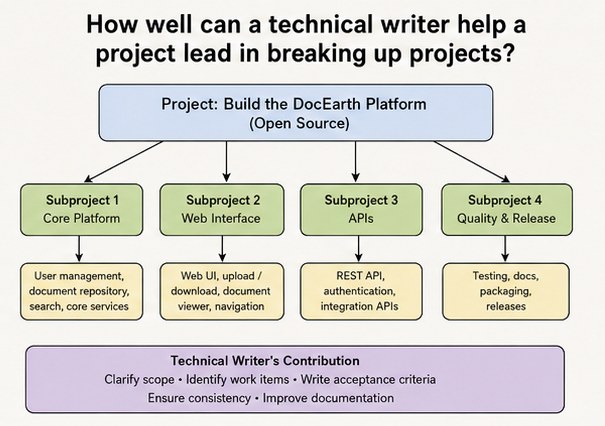
How well can a technical writer help a project lead in breaking up projects?


Today we hired Fatma Ahmed to work with Dale Wick on a pilot project. She will work with him on breaking up one of his projects on FOSS Factory into smaller projects. He will provide the general instructions of how the project will be broken down, and she will write the technical documentation.

The purpose of this project is to see how well, cost effectively and quickly a technical writer can work with project leads on breaking up their projects into components and writing technical specs for them. If that can be done at a reasonable price and time, we will integrate this practice into our business model and to how FOSS Factory works.

We thought of bringing a technical writer (who we, FOSS Factory pay for) into the equation is because we noticed project leads and developers find it time consuming or hard to do.

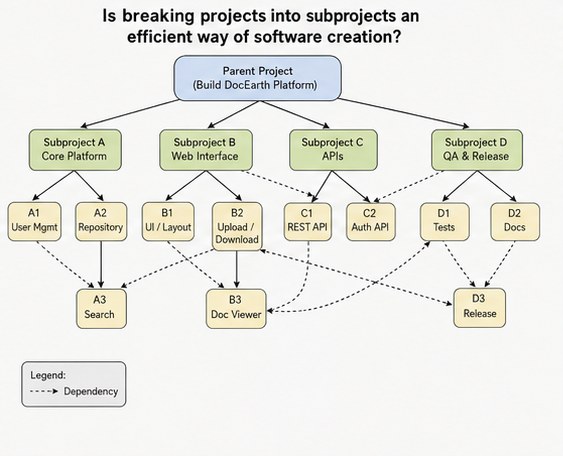
Is breaking projects into subprojects an efficient way of software creation?


Hi there,
Yesterday I was talking to Jay Freeman over the phone, he works with Brian Fox in the Okori group (http://www.theokorigroup.com/). He mentioned an interesting point: no matter how small the sub projects are, people who will develop for those sub projects will still have to spend a significant amount of time to learn about the project overall, things like the language of the project the goal the vision etc.. to the point where the efficiency introduced by this project break-up is annulled. In fact it is less efficient: if one person is assigned on that project, at least they'd learn it once and get the job done.. in the other hand if you have 10 people working on 10 sub projects, they all have to learn the same thing the same time, and then work on them from different perspectives, only adding complexity to the equation.

What do you guys think?

Monday, September 15, 2008

Sept 13 Board of Advisors meeting highlights

Some of our advisers met on Saturday Sept 13th to discuss the current affairs of FOSS Factory. Attendance included John-Paul, Dale Wick, Tom Rathborne, Stephen Egmond, Bill Snow, and myself. Here are some of the major highlights (It's actually the notes I managed to take during the meeting, key points are in bold:)

- in open source projects, like gimp, people get things done one way or another they're not waiting for foss factory.. they have meetings and get things done regardless of money..
- they are not necessarily our target market..
- you have a small core of developers and a large audience who care about these bugs..

- dale: it wasn't worth 80 hours of my time to learn the pidgin structure (when he looked at the video/audio pidgin project https://fossfactory.org/project.php?p=p12, and he looked at the pidgin requirements for developers to get involved, he estimated the time it would take him to be qualified to break the pidgin audio/video project down to be around 80 hours.. he concluded that the barrier to entry for people to contribute to any project is high b/c breaking it down is too complex a project for a layperson to do it.. and probably that’s why not a single project on foss factory has been broken down so far).

- dale: you need to hire people to just go around and break down projects into subprojects..

- dale: connecting the world of academia with industry.. pay for phd developers who are doing their phds anyways..

steve: your marketing dollars should go to such marketing promotion campaigns.. google ad sense is just a waste.. it has to be very targeted.. (note: marketing to go after ubercart..)
- open source: is for kids, people did it when they where in university, when they graduate they slow down on it..
- university students are famous for always being poor.. having a lot of free time (wait till you get kids)..
- they could use their free time to do assignemnts, or troll bars..
- college kids are the developers you wanna go after (grad students are the best.. they dont' have much courses to attend, have free time,

- undergrad kids may do development, but they don't have the experience to break things down..

- Dale: ziff davis round table open source with people have multi million dollar IT budgets..
- one conclusion: the projects that are mostly successful are the ones that are most finely specified..

- project management are usually experienced software developers.. someone who has made all the mistakes.. lot of experience.. experience in consulting.. they have been both the specifier and implementer of these projects.

- dale: seen a lot of failed open source projects that have a bad design: a design that is theoritcally clean, but have too much overhead to implement..

- made a design who's scope is so large, that they won't be able to finish a project like that.. (ie like wine)

What is FOSS Factory?


I'm assuming that most people viewing this blog are familiar with FOSS Factory and the team. For those who aren't, I offer this excerpt from our Business Plan Exec summary:

FOSS, or free open source software, refers to software that is free to use, modify, and distribute. There is a strong proliferation of FOSS; Gartner has recently concluded that by 2011 at least 80% of all commercial software will contain significant amounts of open source code.

Despite FOSS’s continued success, there is still much room for improvement. Most FOSS projects are created and managed by a rare breed of people who enjoy both deep technical knowledge and impressive leadership and management skills, resulting in more open source ideas than those implemented. Even with FOSS projects that are already successful and have a rich community, there are many highly desired features that remain undeveloped for the lack of time and money for developers in such communities.

FOSS Factory offers cheaper and easier means of creating open source software by offering an online model that breaks down the complexity and cost of software production into small chunks that different participants can work on. The model then aggregates the design, funding, and development of these participants to produce open source software .

FOSS Factory’s solution is compelling because it is the first and only site that provides a solution for a whole new market ignored thus far by incumbents: software that is desired by many small entities that individually lack the resources and skills to implement them, and at the same time is the kind of software that is not economically attractive for large corporations. In short, the Long tail software market.

We have a capable management team that has worked together for more than 14 years. Steve Sutherland, our lead investor and advisor brings 3 decades of innovative experience as a serial entrepreneur. He sold some of his start-ups to industry leaders such as Adobe and Best Buy. John Paul, President and founder has been the senior software architect of several start-ups before and has consistently provided unorthodox solutions to complex problems. Abdullah Bakhach, director of business development, is the winner of the 2006 Impact Innovator of the year award and in the company represents the voice of the young and passionate.

To prove the model, a Beta test of the FOSS Factory site was commenced spring 2008. Currently we are engaging specific niches within the open source community: for each niche we offer FOSS Factory as a solution for their needs. In the process we improve site based on their feedback, build credibility and gain exposure. We hope that these beachheads will be a stepping stone into the wider market. The Open Voting Consortium are using our system to build a prototype of voting software to be presented at the Linux World Expo this August. Members of the Pidgin community are using our system to add audio and video chat support to the popular instant messaging client. We’ve also made some significant inroads with the Drupal community in terms of integrating FOSS Factory into their site.

I think that should give you an idea of what we're all about. If you have questions please ask on the forum pertaining to this post. Thanks!

Hello World

Hey everyone, I've finally decided to create a blog. Most of the stuff here will be related to FOSS Factory, I guess I publish enough stuff about myself on Facebook and Twitter already.

The purpose of this blog is to keep all those interested in FOSS Factory up to date with all the new and interesting stuff happening with it.

Considering that we're still tweaking many things on FOSS Factory, there is a lot of room for much needed feedback and constructive criticism. Please don't hesitate to say whatever comes to your mind even if it may come as harsh or negative. I need all the input I can get!

FOSS Factory, IMHO, is a very interesting subject for many people in different fields and backgrounds, it is relevant to open source, open collaboration and innovation, project management, software architecture, economic incentives, human behavior and motivation, marketing, business strategy, psychology, organizational behavior, and much more. As such, there is room for almost anyone to give some really useful feedback to our project. I'm looking froward to that!