Tuesday, November 24, 2026

Choosing Open Source Software Tools for Community Projects

How can a community project keep track of its dependencies without overwhelming volunteers? Learn where component inventories, vulnerability checks and licence reviews fit, and how to turn the results into useful maintenance tasks.

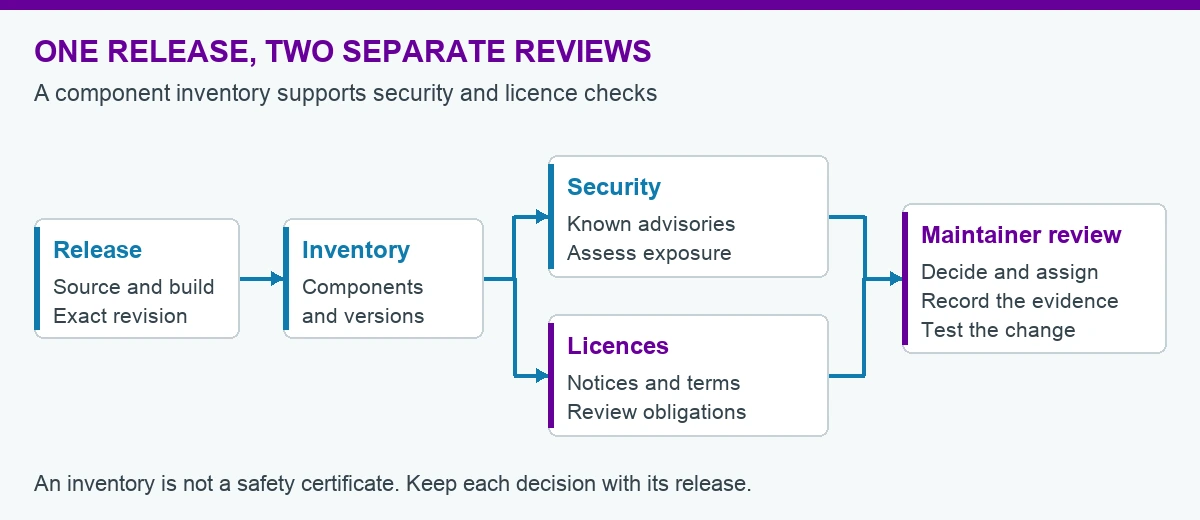
How a component inventory supports security and licence reviews

Read the article

Monday, March 16, 2009

Mobile Free/Open Source Software Development Conference: A Success!!!


The Mobile Free/Open Source Software Development Conference was an outstanding success! (Just in case you missed out, you can see all the videos/slides here!)

The turnout was amazing, and the quality of the presentations were even better! Speakers included Jay Freeman, the famous creator of Cydia, an open source alternative to the iPhone's installer which offers developers much more flexibility when publishing their apps, and Dulpreet Singh, CTO of Life360, an App that won a $300,000 reward from the Android developer challenge, and last but not least Jean-Michel Bouffard who comes from Canada’s prestigious Communications Research Centre, and is a developer in the Openmokast project, which is a Openmoko based platform related to digital broadcasting services.

Jay, Dilpreet and Jean-Michel introduced open source development on the iPhone, Android and Openmoko platforms, respectively. After that they discussed how to create sample applications on their platforms. The night was concluded by an engaging open panel discussion about all three platforms, mobile software development in general and where the industry was heading.

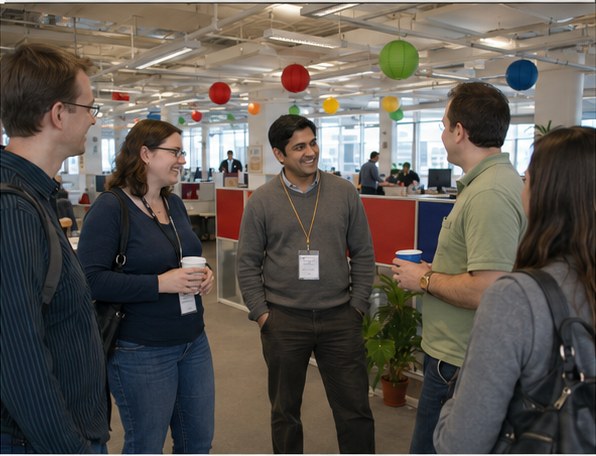
We were invited the following morning to the Google office in Waterloo, where we had an enjoyable chat with the staff. Over all it was a wonderful experience where a lot of really really smart people got together and had some really really deep conversations. I look forward to more of this!

Wednesday, November 5, 2008

Entering the community: Landing page or more integration?


Hi all

John-Paul and I are having this debate about what is the best way to offer FOSS Factory as a service for the Pidgin community (the way we determine that would set an example to be followed with the other communities).

Brief background: we already have a project page for adding audio/video to Pidgin. The question here is how can we best channel users who badly want that feature to FOSS Factory to support it, either by their wallets or design help or development. We agreed that one way of doing that is by having the Pidgin IM client itself notify the user when they want to initiate an a/v chat session that they such feature is not available, but they can support it by going to the corresponding FF page. (details of this can be seen here)

Here are two options

1. Landing page

In this case users would be linked (from the pidgin IM client) to a landing page, this landing page will contain the general branding of pidgin, would explain what FOSS Factory is all about and so on, then lead them after that to the corresponding FOSS Factory page. (See more details of this here)

The good news w/ this approach is that it has a very easy and quick implementation. It benefits FF by channeling the Pidgin crowds to us (so they can check out other projects on FF as well), it also benefits Pidgin by giving it more exposure from the community (ie people not necessarily involved w/ Pidgin will see the project page on FF and may join in).

The bad news is that it takes Pidgin users out of the Pidgin site. In my experience people are usually resistant to that, especially when they already have their own online project management tool (ie trac) they got their own bug tracker mailing list and so on, and here we are to replace that.


2. More integrated approach

In this approach we would integrate FF with the project management system in Pidgin (ie trac), without duplicating any of the features already offered by trac on Pidgin. So we would add for example adding a bounty on a ticket (or bug or whatever), the ability to break a ticket down etc. (for a more details go here.

pro: It gives more exposure to FF. The pidgin community can work on other projects using the FF platform without being alienated by being asked to go to a foreign site.
Furthermore, if we decide to implement a custom FF within pidgin
and stop there that would eliminate the benefit of getting other users exposed to Pidgin through Fossfactory.org. However one idea JP and I thought of was to integrate FF with trac within pidgin and at the same time make a mirror of it on fossfactory.org itself. An example would be suppose you create a project for "Track tab history" on the pidgin site (using FF, so you give it a bounty and so on). As soon as the project is created we automatically create the same project on fossfactory.org. This mirrored project will reflect all the changes made on the pidgin site: comments, requirement changes, bounties and so on.

This may be dismissed as a redundancy. I think not: the FOSS factory site would be a distribution channel for pidgin. The power of this channel may not be obvious at this point b/c we lack heavy traffic but I'm sure in the future the benefit will become more evident..

we also thought of using openID to make the transfer of pidgin users into FF and vice versa easier (but that's an advanced topic by itself)..

What do you guys think?

Tuesday, October 28, 2008

reason #143 why open development is better than contractual dev.

so we hire this guy from india through a site that hooks up a person with a need with a developer (think elance odesk code for hire etc.. doesn't matter which).

so the guy submits us some code that don't fill the requirements.. right, i ask him to do it again.. he takes another 2 weeks and submits the code again. I hand it over to our dev to evaluate the code and this is what i get: (basically the dude was supposed to create a blog and a news feed (think of facebook news feed page) for each project that's on fossfactory)

Abdullah,

This code is probably the worst that I've ever seen. We won't be able
to use it. If there's any possibility of getting our money back, that
would be fine, but don't bother trying to get them to finish the job
because there's nothing worth finishing.

It's difficult to express how bad this code is. They started by
giving us a bungled cookie-cutter blog solution. They then proceeded
to hack it into our template with absolutely no concept of what our
site was about, or what this project was for. They didn't even bother
to develop a basic understanding of the structure of the very page
that they were working on. Instead, they made multiple copies of the
project page and tweaked each one to behave slightly differently for
different actions that a user might take. (Don't ask -- it doesn't
make any sense.)

They also didn't have the common courtesy not to stick us with all of
the stuff from the original cookie-cutter solution that was no longer
used in the end. And the developer neglected to do even basic
start-to-finish testing.

Just a few of simple examples of how bad this is. The blogs are
associated with the member instead of with the project. That means
that if the project lead leaves, he takes the blog with him. It also
means that if the project lead has multiple projects, they all share
the same blog.

Oh, and by the way, the blog isn't created automatically. Instead, if
you try to make a post, it spews some SQL errors. You have to create
your blog first. To create your blog, you visit createblog.php. Did
I mention that there's no link to createblog.php? (You have to just
*know* to go there.)

Here's a bizarre one: Every time any user *views* a project page that
they haven't viewed before, it adds a news feed item: "abbood just
watch this project".

The project news feed sidebar should be a brief form of our
already-existing activity tab. Instead, they created a redundant
newsfeed mechanism, effectively doubling the maintenance cost.

In short, the developer obviously did this work with no sense of pride
whatsoever, not even bothering to do basic sanity checks to see
whether what he thought we were asking for made any sense at all.

Note that the above issues are merely some of the most glaring
problems. Don't imagine that it's an exhaustive list.

That's all I have to say about that.

Please become the project lead of p64 and reject the submission (not
with prejudice).
Friday, October 10, 2008

Let the experiment begin: How can FOSS Factory + Software architects help accelerate open source

I'm glad to announce that we've got the ball rolling on the software architecture experiment front. We've signed up 3 software architects to work with project leads of 3 open source project:

The software architect Stephen Van Egmond (picture) will be working with Eric Richie & Elliott Harris, both Adium developers and community leaders.

The software architect Bill Snow will be working with Richard Laager, Sean Egan and Maiku who are involved with Pidgin.

Both the Pidgin and Adium projects will be focused on creating audio and video chat support for them. Both Adium and Pidgin are user interfaces that rely on the Libpurple library, hence we expect a lot of collaboration between the two teams on this particular project, this will be interesting.

The software architect Tom Rathborne will be working with Dale Wick on creating an mp3 decoder from home brew video game developers.

The parties now are getting to know each other and will soon start work. The good news is that the development process will be open: discussions will be made on the project forums viewable to all. So as developers, designers and funders interested in these projects (I know a lot of you use Pidgin and Adium out there) you can see exactly whats going on, and perhaps identify a point where you can be of help!

Tuesday, September 23, 2008

Technical Writer vs Software Architect


The first technical writer we hired to work on with a project lead to break an open source software project down into subprojects concluded that she is under qualified. The following are key excerpts of a chat between her and the project lead.

[09:28] Project lead: So, here is what I suggest:
[09:29] Project lead: - a platform specific hardware binding API for the MPEG decoder to talk with that platform's sound output
[09:29] Technical writer: ok
[09:31] Project lead: - a subproject to factor out the MPEG decoder from SDL in SMPEG
library, and remove the dependency on SDL, and instead use the hardware binding API.
[09:31] Project lead: - a subproject for each target platform to implement the hardware
binding API for that platform.
[09:32] Project lead: that's the high level of what needs to be done.
[09:32] Project lead: so what should we do next?
[09:33] Project lead: Maybe you should ask me some questions to better understand each
of those?
[09:35] Project lead: Oh, I think I missed: - define the API for the library, and create two samples to that uses the library; one basic playback, and one that uses all features.


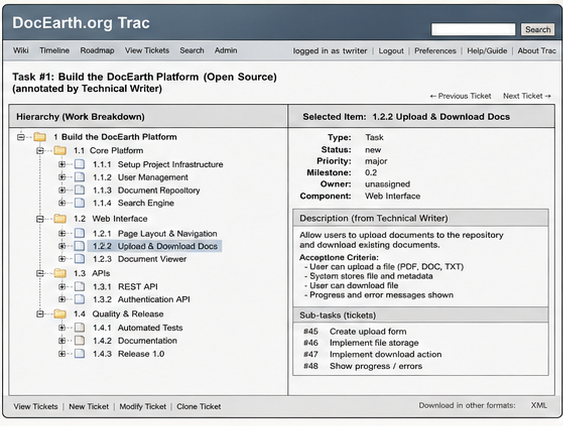
It seems that these requirements overwhelmed our technical writer. As such she thought it would be better if we fine someone more qualified. We're currently looking to hire someone who has experience in software design and development as well as documentation (see image).

Other developments:
1. Today we signed the contract with Emblematiq to redesign our home page.

2. I'm reading the book Essential Software Architecture by Ian Gorton. The book was recommended by software architecture Proff at UW Richard Holt. Hopefully I come up w/ something interesting out of it.

Thursday, September 18, 2008

Pidgin and Adium


Hey all,

Today I got back in touch with the guys from Pidgin and suggested the work with the technical writer we hired to break down the project into subprojects. He agreed though he said that he highly doubts that the A/V project could be broken down so that they're discrete enough to be effectively tackled by unrelated developers.

I responded by saying that there are many doubts, but empirical evidence concludes all discussion, to which he agreed.

Anyways another development was talking to the Adium guys. Adium is a protocol agnostic instant messaging client like Pidgin. I suggested they work with our technical writer as well on adding A/V to Adium itself (something like a sister project for Pidgin). They responded positively, however one interesting point they mentioned was that bounties haven't helped them much because a few people have the knowledge to do the work required.

Anyways we will work them on the idea further and see how far we can go with it.

Other developments:
I've tried hiring a company through Odesk from India. They're still going over the code of FOSS Factory and trying to understand the whole system. They said they will start work tomorrow. So far it seems that these folks are professional, responsive and have good communication skills. Hope things run smoothly.

Wednesday, September 17, 2008

Amazee, hiring overseas, home redesign and other developments


Hey folksters,

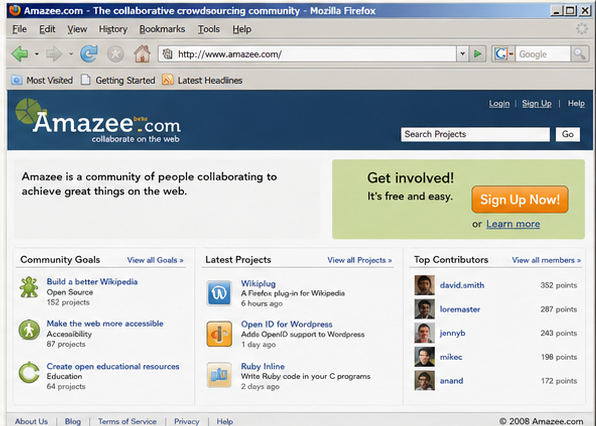
Today Ron Newman, an advisor of ours, asked me to take a check out Amazee.com

This is my take on the site. First off, like Cambrian House, they're everything to everyone. This invariably results in goals that are as diverse as it gets (with lots of very low quality ones, one goal i found on the site was to keep my house clean) Cambrian house is a proven failure by the way.

Very few projects have got traction, and those that did have the founders of the site as project leads on them. Further, after looking at those projects it's not clear how amazee is anything more than a forum for a social movement. If Amazee's goal is to gather social groups around causes, then I think they're a little behind: Mark Andreseen has already implemented a site for that called Ning.

Amazee also reminds me of Kulster, another web 2.0 start up that helps collaboration. Kluster has an interesting twist to it though: soon after launch they realized that there wasn't much traction to their original everything-to-everyone model, so they quickly adjusted their business plan and made kluster a service to be customized for corporations in house use. The success of their customized approach is yet to be seen, but the failure of their original business model was confirmed even by their CEO who posted a video about the subject on their home page. The video is not available anymore.

In conclusion, none of these guys constitute a serious competitor to FOSS Factory. However, the multitude of such ideas (perhaps due to the low barrier to entry) and their subsequent less than inspiring performances does cause people to be jaded with ideas like our own. Hopefully we manage to cut through the cynicism and create a sustainable success.

Other developments today: I've tried to hire a couple of guys from India via Odesk to work on some bugs and features we would like to add to FOSS Factory. They're supposed to start working tomorrow. Also I'm trying to get hold of a good designer to redo our awkward homepage. We've contacted Lucian from Emblamtic a while back I hope he is still available for the job. If you know of some top of the line web design artists please let me know.